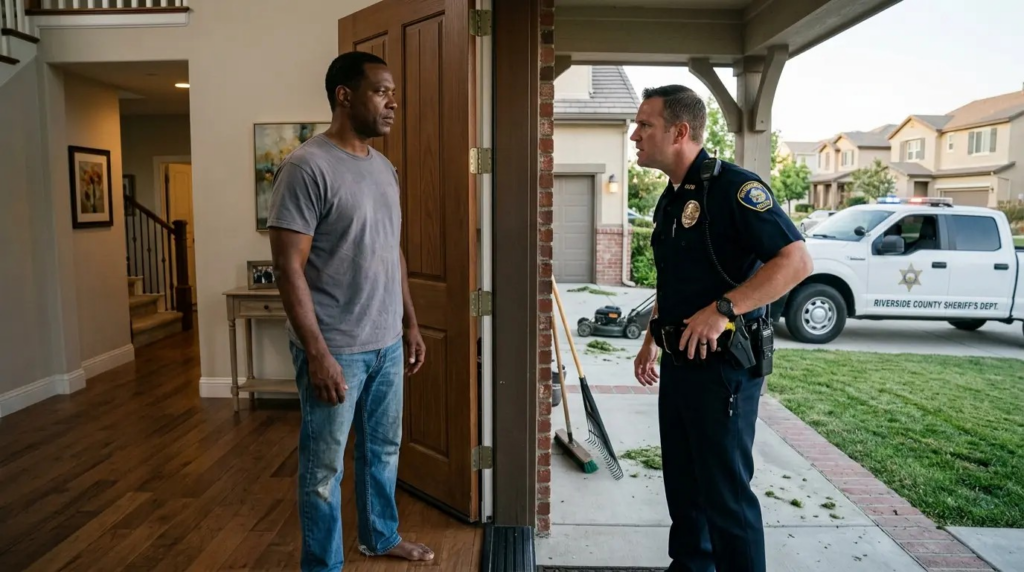
Cop Tasers Black Ex-Deputy at His Home — Ring Cam Caught Everything and Leads to $6.8M Lawsuit
Theme:
Font Size:
“Step out here right now.”
“I’m fine where I am. You haven’t told me why you’re here.”
“I said step outside. Don’t make this harder than it needs to be.”
“Without a warrant, you don’t come in my house. Fourth Amendment. I’m not stepping out.”
“Last chance.”
Officer Scott Harland, badge number 6129 of the Riverside County Police Department, made the worst decision of his 11-year career when he saw a Black man doing yard work in an upscale neighborhood and decided something didn’t look right.
He circled back 10 minutes later, approached the house with his hand near his weapon, and when Derek Vaughn answered his own front door, Harland demanded he step outside for questioning without any legal justification. When Derek, a retired sheriff’s deputy with 22 years of service, calmly refused and cited his Fourth Amendment rights, Harland forced his way into the doorway and deployed his taser, sending 50,000 volts through Derek’s body while he stood in his own entryway.
What Harland didn’t know was that the Ring doorbell camera had captured every second in crystal-clear HD with perfect audio—that this footage would go viral within 48 hours, and that his moment of racial bias would lead to a $6.8 million lawsuit that would bankrupt not just him, but his entire family.
Derek Vaughn had spent his entire Saturday afternoon doing something he had dreamed about for years. At 48 years old, after 22 years as a county sheriff’s deputy, he had finally retired with a full pension and bought the house he had always wanted. The two-story home in the Riverside Meadows neighborhood was everything he and his wife Nicole had saved for.
They had closed on the property just two weeks earlier, and Derek was still in that excited phase where every task felt meaningful. Mowing the lawn wasn’t a chore; it was taking care of his investment. Trimming the hedges wasn’t work; it was making his new home beautiful.
He had spent the afternoon outside in old jeans and a faded t-shirt, pushing the mower across the front yard, edging the walkway, and cleaning up the flower beds that the previous owners had let grow wild. The September sun was warm but not unbearable, and Derek worked steadily, occasionally waving at neighbors he was just beginning to meet. A white couple two houses down had introduced themselves the previous weekend. An elderly woman across the street had brought over cookies as a welcome gift. The neighborhood felt safe, quiet, and exactly what Derek and Nicole had wanted for this next chapter of their lives.
His sheriff’s department career had been demanding, sometimes dangerous, and always stressful. He had worked patrol, served warrants, handled domestic violence calls, and dealt with the worst aspects of human behavior for over two decades. This house, this neighborhood, and this peaceful Saturday afternoon represented everything he had earned.
Around 4:00 in the afternoon, Derek finished the yard work and headed inside through the front door. His white Ford F-150 sat in the driveway, lawn equipment scattered near the garage, and grass clippings still visible on the walkway where he planned to sweep them up after grabbing some water. Inside the house, Nicole was in the kitchen preparing dinner, and the smell of seasoned chicken filled the air.
Derek washed his hands at the kitchen sink, dried them on a towel, and was reaching into the refrigerator for a cold bottle of water when he heard the loud, aggressive knocking on the front door. The knocking wasn’t polite. It wasn’t the gentle tap of a neighbor stopping by. It was the heavy, authoritative pounding that Derek recognized immediately from his years in law enforcement: someone was at his door, and they wanted attention right now.
Derek walked to the front door, glanced at his phone to check the Ring doorbell app, and saw a Riverside County police officer standing on his porch. The officer’s hand was resting near his duty belt, his posture tense and ready. Derek felt a flicker of confusion, but no real concern. Maybe there was an incident in the neighborhood; maybe they were canvassing for witnesses to something. He opened the door with the casual confidence of someone who had worn the same uniform for most of his adult life.
Officer Scott Harland had been patrolling the Riverside Meadows area for the past hour, driving slowly through streets he considered his territory. At 37 years old, with 11 years on the force, Harland had developed what he called “instincts” about people and places. Those instincts had generated 14 civilian complaints over his career, most of them alleging racial profiling or excessive force. Internal Affairs had reviewed eight of those complaints and found patterns that concerned some supervisors, but Harland had never faced serious discipline. He knew how to write reports that justified his actions, knew which supervisors would back him up, and knew that most complaints disappeared into administrative files without consequences.
When Harland had driven past the house on Oakmont Drive and seen a Black man mowing the lawn, something in his mind flagged it as wrong. The neighborhood was predominantly white, the houses expensive, and the image of a Black man doing yard work triggered an assumption Harland didn’t even consciously recognize as racist. He thought the man might be a landscaper, or maybe someone casing the house, or possibly a squatter who had moved into a vacant property. The possibility that the man simply lived there and was taking care of his own lawn didn’t register as likely in Harland’s worldview.
Harland had circled the block and come back around 10 minutes later. The lawn mower was still in the driveway, but the man was gone. Harland parked his patrol car at the curb, studied the house for a moment, and decided to make contact. He approached the front door with the confidence of someone who believed his badge gave him the right to question anyone about anything.
When Derek opened the door, Harland saw exactly what he expected to see: a Black man who looked like he had been doing physical labor, standing in a house that Harland assumed he didn’t belong in.
“Step outside,” Harland said, his voice carrying the flat authority of command rather than request.
Derek blinked, surprised by the tone. “Officer, can I help you? What’s this about?”
“I said step outside,” Harland repeated, his hand moving closer to his taser. “Don’t make me ask again.”
Derek’s confusion deepened, but his training kicked in automatically. He kept his hands visible, his voice calm, and his body language non-threatening. “This is my house, officer. Can you tell me why you need me to step outside?”
Harland’s eyes narrowed. “I saw someone matching your description outside this residence earlier. I need to verify you have a right to be here.”
“You saw me,” Derek said evenly. “I was doing yard work. I live here. This is my property.”
“Then you won’t mind stepping outside so I can verify that,” Harland said, and the way he said it made clear he didn’t believe Derek at all.
Derek felt the familiar weight of something he had experienced before, but never quite like this. He had been pulled over for driving while Black. He had been followed in stores. He had felt the sting of assumptions based on his skin color. But standing in the doorway of his own home, being ordered outside by an officer who saw him as a threat rather than a homeowner, carried a different kind of violation. He had spent 22 years as a deputy. He knew the law. He knew his rights. And he knew that what Harland was demanding had no legal basis.